New Scots: A Pathway to Social and Economic Inclusion
| Project Name: | AMIF New Scots: Pathways to Social and Economic Inclusion |
|---|---|
| Project Timeframe: | October 2020 - December 2023 |
| Researchers involved: |
Dr Marcia Vera-Espinoza (Principal Investigator), Dr Alison Strang, Dr Arek Dakessian, Dr Helen Baillot, Dr Emmaleena Käkelä, Leyla Kerlaff, Marcus Fernandes, Gianluca Palombo, and Dr Nicole Vidal |
| Division / Research Centre: | Institute for Global Health and Development |
| Associated Project Website: | AMIF New Scots: Pathways to Economic and Social Inclusion — Migration, Integration, Social Connections |
About this Project
The project addressed a significant evidence gap regarding how social connections influence refugee integration and inclusion over time. While refugee integration policy often recognises the importance of social networks, limited research had explored how relationships are formed, maintained and experienced by refugees in everyday contexts, or how organisations can effectively support these processes.
The project aimed to better understand the role of social connections in pathways to social and economic inclusion among recently recognised refugees in Scotland. It also sought to examine how third-sector organisations and integration services foster meaningful relationships that support wellbeing, agency and participation.
The research adopted a participatory mixed-methods approach grounded in the social connections framework developed within refugee integration research. Quantitative data were collected using the QMU Social Connections Mapping Tool to assess the extent, quality and significance of social networks. Qualitative methods included interviews, participatory workshops and collaborative reflection sessions with refugees, practitioners and partner organisations.
The project combined academic research with ongoing engagement with frontline services to ensure findings could directly inform practice development, policy discussions and future integration programming.
- Project Objectives
- Partners
- Funding
- Outcomes
- Impact
- Explore the role of social connections in refugees’ pathways to social and economic inclusion
- Understand how integration services and third-sector organisations support relationship-building and community participation
- Test and apply the QMU Social Connections Mapping Tool within practice settings
- Generate quantitative evidence on the extent and quality of refugees’ social networks
- Undertake qualitative research into the meaning and development of social connections over time
- Support practice development through collaborative workshops and knowledge exchange with frontline practitioners
- Inform refugee integration policy and service delivery in Scotland
- Amplify refugee voices and lived experiences within integration research and practice
- Scottish Refugee Council, Glasgow, UK
- Bridges Programmes, Glasgow, UK
- Workers’ Educational Association (WEA), UK
- Institute for Global Health and Development (IGHD), QMU, Edinburgh, UK
Funded through the European Union Asylum, Migration and Integration Fund (AMIF) as part of the New Scots Refugee Integration Delivery Project and the wider New Scots Strategy.
Associated AMIF Project Reference: UK/2020/PR/0109.
The project generated substantial evidence on the importance of social connections in refugee integration pathways. Findings demonstrated how relationships with family members, peers, local communities, service providers and institutions influence wellbeing, belonging, employment opportunities and access to services.
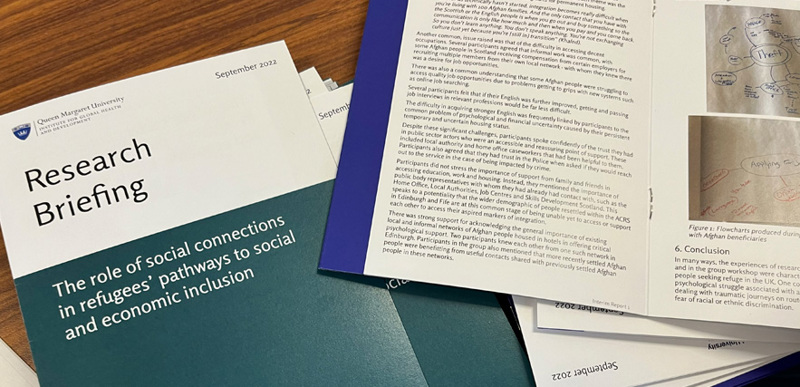
The project produced a series of interim reports, executive summaries, research briefings and a final report documenting findings from 2020–2023. It further refined and applied the QMU Social Connections Mapping Tool within integration practice settings.
Workshops and collaborative reflection sessions supported knowledge exchange between researchers and frontline practitioners, enabling research findings to inform service delivery and integration planning in real time.
The project also contributed to wider academic and policy discussions on refugee integration, participatory methodologies and social connections approaches in humanitarian and migration contexts.
The project contributed to improved understanding of refugee integration in Scotland by demonstrating the central role of social relationships in promoting wellbeing, participation and long-term inclusion. Findings informed integration services and supported more person-centred approaches to refugee support planning.
Societally, the research amplified refugee voices and experiences, helping organisations and policymakers better understand barriers to inclusion and opportunities for community participation. The project strengthened collaboration between universities, third-sector organisations and refugee communities, supporting more inclusive and evidence-informed practice.
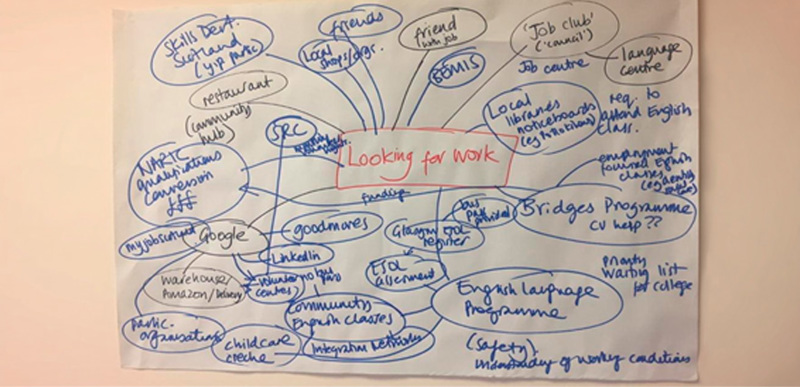
Economically, the research highlighted how social connections influence access to education, employment and community resources, contributing to refugees’ social and economic participation.
The project also enhanced the evidence base underpinning the New Scots refugee integration strategy and supported the development of tools and practices that can be adapted across different local authority and service contexts in Scotland and beyond.