Adapting methods to assess social connectedness and well-being among young refugees in Scotland and Lower Saxony
The CONNECT-WELL project explores how to improve qualitative research methods aimed at assessing the well-being and social connections of refugee children and youth. Most existing methods have been designed for adults or based on Western ideas of well-being and social relationships.
In this project, we work directly with young refugees in Scotland and Lower Saxony to test and adapt participatory and culture-sensitive methods. The project will also lay the groundwork for a larger future comparative study.
| Project Name: | CONNECT-WELL: Adapting methods to assess social connectedness and well-being among young refugees in Scotland and Lower Saxony |
|---|---|
| Project Timeframe: | 09/2025 - 08/2026 |
| Researchers involved: |
Professor Marcia Vera Espinoza Prof. Cordula von Denkowski (Co-PI) |
| Division / Research Centre: | Institute for Global Health and Development |
About this Project
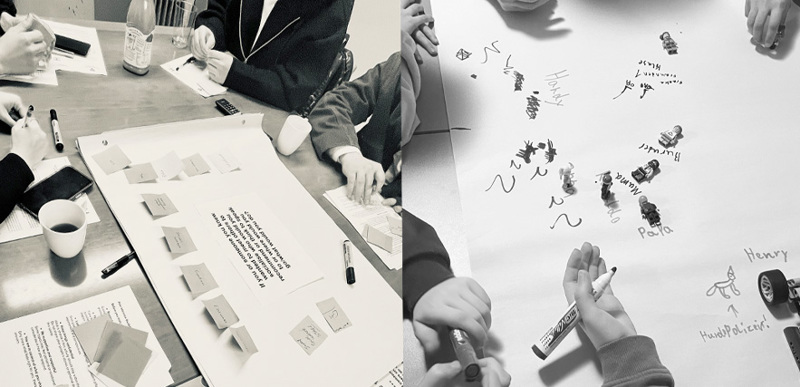
The CONNECT-WELL project adopts a qualitative, participatory design to test and adapt existing methods for assessing refugee children’s and youth’s social connectedness and well-being. The focus is on developing culturally sensitive tools that are appropriate across age groups, genders, and ethnic backgrounds and that recognise young people as active social actors rather than passive data sources.
The project builds on prior methodological work on children’s wellbeing in non-Western settings (e.g., Crivello et al., 2013) and existing tools to measure social connectedness in refugee populations (Kerlaff et al., 2023), which to date have primarily been applied to adult samples.
By combining and adapting these approaches, the project seeks to develop methods that are both culturally appropriate and accessible to children and youth in forced migration contexts. This pilot study takes place in two sites: Scotland (UK) and Lower Saxony (Germany), to ensure cross-context testing and to explore how methods transfer across different settings.
- Project Objectives
- Partners
- Funding
- Outputs
Research Questions:
- How can existing qualitative methods for assessing well-being and social connectedness be adapted to be culturally sensitive and appropriate for refugee children and youth?
- What methodological challenges arise when applying and adapting these tools in different national and cultural contexts (Scotland and Lower Saxony)?
- How do refugee children and youth themselves assess the usefulness, accessibility, and relevance of these methods?
- How can the adapted methods inform the design of a robust future comparative study on social connectedness and well-being among young refugees?
Research Objectives:
- To test and adapt qualitative methods for assessing social connectedness and well-being of refugee children and youth.
- To design a future comparative study on social connections and well-being in young refugees living in Scotland and Lower Saxony. This study will employ the methods tested and adapted in this project.
Prof. Cordula von Denkowski (Co-PI), Hochschule Hannover
Royal Society of Edinburgh Scotland-Lower Saxony Research and Innovation Scheme, Grant Number 5377
Vera Espinoza, M. & von Denkowski, C. (2026). CONNECT-WELL: What young refugees taught us about researching wellbeing and social connections. 22 June 2026. Available at https://www.qmu.ac.uk/campus-life/blogs/ighd/connect-well-what-young-refugees-taught-us-about-researching-wellbeing-and-social-connections
Vera Espinoza, M. & von Denkowski, C. (2026). Research Brief: CONNECT-WELL: Lessons for Participatory Research on Social Connectedness and Wellbeing Among Young Refugees in Scotland and Lower Saxony. Queen Margaret University & Hochschule Hannover. https://eresearch.qmu.ac.uk/items/0b53892e-400f-4fa0-84b8-c341a80b9e4a