
Postgraduate Taught
PGDE Secondary (Home Economics)
Looking for a career change? Being a Home Economics teacher may be the change you are looking for. Our one-year PGDE Secondary in Home Economics prepares you to teach in Scottish secondary schools and provides an internationally recognised teaching qualification. The course is ideal for those passionate about food, textiles, sustainability, health and wellbeing and social justice. As a graduate, you will help equip young people with the knowledge and skills needed for 21st-century citizenship, supporting both community and global wellbeing.
Retraining as a teacher offers an inspiring and socially meaningful career path, enabling you to make a positive difference in young people’s lives while drawing on the knowledge and skills developed through your previous studies and experience. If you are a graduate in food, nutrition, professional cookery, or textile technology, with some background in food science, family studies, and health, this course can be the first step towards a rewarding, inspiring, and socially impactful career. Scottish students embarking on a PGDE for the first time are eligible for funding from SAAS.
Throughout the course, you will explore contemporary issues such as sustainable food production and consumption, the environmental impact of fast fashion, food poverty, children’s rights, and inclusive practice. You will also examine the role of Home Economics teachers in shaping the subject within modern social, cultural and political contexts. Professional enquiry is a key part of the course. You will learn how to conduct classroom research and use evidence-based approaches to support pupil learning and improve educational outcomes.
In previous years, this course has been eligible to receive Scottish Government teaching bursaries. It will be confirmed in due course whether this will be available for entry in 2026.
Why QMU?
- Guaranteed employment for one year following graduation: Scottish students are guaranteed paid employment for one year in a Scottish secondary school as a home economics teacher if they choose to follow the GTCS Teacher Induction Scheme route.
- Historical and current expertise: Study at a university with an unrivalled 145-year history of teaching in this field. QMU is well known for its work in food research and hosts the Scottish Centre for Food Development and Innovation.
- Staff expertise: Our staff are either qualified Home Economics teachers or secondary education specialists with many years of experience supporting students entering the teaching profession.
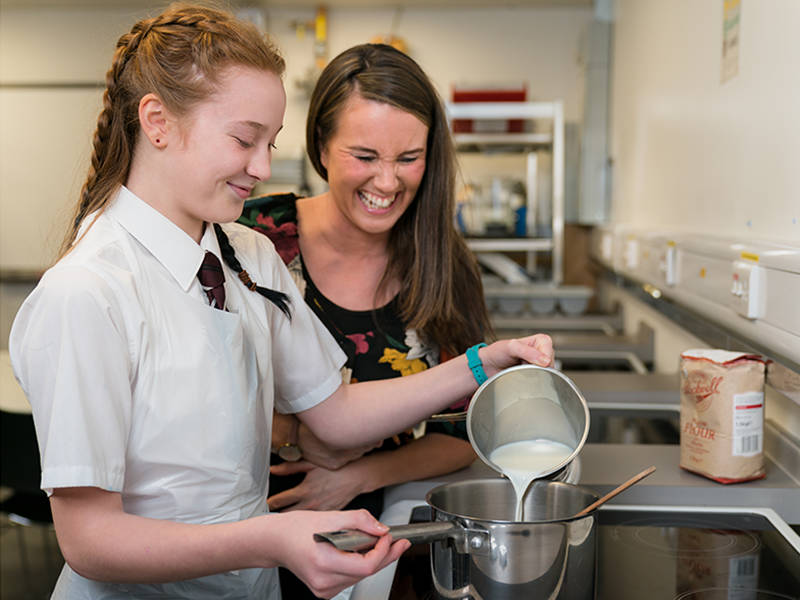
- Range of learning experiences: As well as offering you the opportunity to learn how to teach practical food, nutrition, and textiles skills in a classroom context, you will engage creatively with the role of outdoor learning in the HE curriculum, gaining experience of cooking outdoors in our special campus Outdoor Learning space.
- Make a difference: Become a Home Economist with the power to shape young persons’ lives and community health. As a graduate of this course, you will be an advocate for sustainable lifestyles and health and wellbeing.
- Professional accreditation/registration: The course is accredited by the General Teaching Council for Scotland (GTCS). As a graduate, you will be eligible to register with the GTCS to teach anywhere in Scotland.
Interview with a student
Structure and exit award
PGDE (120 credits) - 80 of these 120 credits may possibly be taken at Master's Level 11. You must complete the full PGDE.
Teaching, learning and assessment
Teaching consists of independent and collaborative learning in workshops. You will engage in research and produce two written assignments and two individual presentations, all of which will be either assessed at Level 11 (Master's degree level) or Level 10.
Assessments are designed to:
- optimise accessibility for students with a range of strengths and abilities;
- provide a variety of opportunities to be challenged and to excel;
- engage students in the importance of being literate and communicative in a range of formats and media; and
- model and demonstrate assessment procedures for student teachers so that they can incorporate these into their own teaching practices.
The PGDE shares the pedagogic approach of the other courses in the Division of Psychology, Sociology and Education, foregrounding:
- critical thinking;
- student collaboration;
- independent learning;
- involvement with real-world issues;
- interprofessional, interdisciplinary learning;
- practical experience, experiential learning and critical reflection;
- practical upskilling in food and textiles;
- peer/group work;
- enquiry-based learning;
- debate and contention; and
- outdoor learning activities.
Placement
Placements are an invaluable way to build on your theoretical and practical learning and to see evidence of how teaching Home Economics can benefit young people.
You will complete an 18-week placement in two different secondary schools in Scotland. Placements are allocated based on schools’ availability within a 90-minute radius of a student’s term-time address.
Please see the 'Entry requirements and application information' tab for information on placement-related costs.
Teaching hours and attendance
This is a full-time, demanding course, lasting 36 weeks in total, split into 18 weeks of campus teaching and online learning and 18 weeks on placement.
Class sizes
This is likely to be capped at around 28 students, but has yet to be confirmed for 2027 entry.
Teaching staff
You can read more about the teaching staff on this course at the bottom of this page. Please note that teaching staff is subject to change.
- Reflective and Critical Practice (Placement modules) (40 credits): This module has a particular focus on your achieving the GTCS Standard for Provisional Registration. This module is assessed through observation of teaching practice in Schools at SCQF Level 10 and through your maintenance of an e-portfolio of evidence-based practice.
- Home Economics in the 21st Century (40 credits): This module aims to equip you with the skills to teach practical food and textiles lessons within Home Economics departments in a secondary school context and to engage critically with research to inform your approaches to transformative learning in schools. Assignments are research-based: one is a recorded presentation, and the other is a written submission. Both elements must be passed to achieve this module.
- Education: Theory, Practice & Research (1) (20 credits): This module will develop your critical reading and writing skills in relation to critical enquiry related to theories of learning, assessment and curriculum, which will enable you to produce a literature review on a chosen topic.
- Education: Theory, Practice & Research (2) (20 credits): This module will develop your skills in preparing a research proposal to undertake classroom research. You will create a research proposal plan and present it to a live audience.
Retraining and working as a teacher can be an incredibly rewarding experience. Not only does it offer you a quick and easy route to a new career, but it also offers you the opportunity to make a real difference in people's lives, whilst utilising skills and knowledge that you will have already acquired in your career journey so far.
The PGDE has been introduced at QMU due to demand for teachers in Home Economics, Business Education, and Religious, Moral and Philosophical Studies, and job prospects are likely to be good. On graduation, Scottish students are guaranteed a job for one year in a Scottish school following graduation as part of the GTCS Teacher Induction Scheme. After graduating, candidates register with the GTCS for provisional registration and, upon successful completion of a probationary teaching year, are awarded full registration.
When a person successfully completes a teacher education programme at a Scottish university, they will receive a teaching qualification. By law, they must register with the GTCS before they can be employed as a teacher in a Scottish local authority school.
Newly qualified teachers will commence on a probationary year's salary in Scotland. Secondary teachers may receive additional money if they choose to complete their probationary year anywhere in Scotland. Once you are fully registered, your salary will increase incrementally over the first six years. More information on teacher salaries is available and updated on the EIS website.
The Teacher Induction Scheme offers a guaranteed one-year training post to every eligible student graduating with a teaching qualification from one of Scotland’s universities.
A PGDE is an internationally recognised teaching qualification, and you would be eligible to register with an appropriate teaching council to work in another country, whether that be elsewhere in the UK or internationally. More information on pay scales for England can be found on the National Education Union website and for Wales, the NASUWT website.
Entry requirements
Successful applicants must, as a minimum, meet the requirements as set by the Memorandum on Entry Requirements to Courses of Initial Teacher Education in Scotland produced by the General Teaching Council for Scotland (GTCS), which specifies general entrance requirements for all applicants and subject-specific requirements for secondary applicants. Shortlisted applicants will be invited for an interview.
The minimum entry requirements are:
- A degree validated by a higher education institution in the United Kingdom (UK) or a degree of an equivalent standard from an institution outside the UK.
- Applicants must have a degree with 80 SCQF credit points including 40 SCQF credit points at SCQF Level 8 (or above) from degree level study in either food, nutrition or professional cookery programmes or textile technology programmes.
- The other 40 credits can come from the above or any of the other relevant areas outlined below:
- Family Studies: parenting, childhood studies, family lifestyles, socioeconomic influences or environmental issues.
- Food Science: food chemistry, composition of foods, processing and manufacturing of foodstuffs, functional properties of foods, biotechnology or microbiology.
- Health: health promotion, health education, determinants of health, lifestyles and health, environmental issues, or health and food policies.
- Professional Cookery: Practical food preparation skills, food preparation techniques, safety.
plus
A National Qualification in English at SCQF Level 6, for example:
- Higher English Grade C or above
- GCSE English Language and English Literature, at 4/C or above in both
and
A National Qualification in Mathematics at SCQF Level 5, for example:
- Standard Grade (grade 1 or 2 only) / Int 2 / National 5 Mathematics Grade C or above
- GCSE Mathematics at 4/C or above
NB: National 5 Lifeskills/Applications Mathematics is accepted in place of National 5 Mathematics.
International students: You will be required to provide evidence of English language competence at no less than IELTS 6.5 with no individual component score less than 6.0.
Accreditation of prior learning: You may be granted exemption from studying a module or modules up to a maximum of 60 credit points, provided you can demonstrate successful achievement of all the learning outcomes.
Other requirements
A satisfactory criminal records check from the Protection of Vulnerable Groups (PVG) Scheme.
Disability/health conditions
If you have a disability, long-term physical or mental health condition, or learning disability, it should not stand in the way of your studying at QMU. However, if you are not sure whether your disability might be a barrier in your studies or in relation to the professional standards, please contact the disability service who will be able to have a conversation with you about reasonable adjustments and supports available to you.
Other costs
- The additional costs associated with placement travel and accommodation are the responsibility of the student.
- The cost of the PVG check is the responsibility of the student.
Applying for this course
You should apply for this course as part of the UCAS undergraduate scheme before 13 January 2027. Late applications may be accepted if space remains, please contact Admissions to check.
UCAS code: 0001
So that we can fully consider your application, you will need to provide supporting documents to QMU's Admissions team as soon as you have applied. Failure to provide these means we will be unable to assess your application.
Please contact Admissions provide the following:
- Your degree certificate (if already awarded)
- Your academic transcript listing all the modules you have completed
- Evidence of Higher English (or equivalent) if already awarded
- Evidence of National 5 Maths (or equivalent) if already awarded
Application deadline
The UCAS deadline is the 13 January 2027. Late applications may be accepted if space remains.
For admissions or eligibility enquiries, please contact Admissions.
Alternatively please contact Katie Thomas (Programme Leader)
- The delivery of this course is subject to the terms and conditions set out in our 2027/28 Entry - Terms and Conditions (Postgraduate).
- The information on this page is correct at the time of posting (October 2026) but is subject to change. In the event that modules change, QMU will seek to use reasonable endeavours to ensure that there is no detrimental impact on students. Please keep an eye on this page for updates.
The experience of being a Home Economics teacher: interview with a working teacher
Become your best you: study at QMU
Course Overview
Delivery
On campus at QMU and on placement
Duration
1 year full time
Start Date
August 2027
Start Date
July 2001
Division
Fees & Funding
UCAS Code
0001
SCQF Level
11
Useful Links
Are you eligible for the Scottish Government's teaching bursary?
Join us at one of our Postgraduate Open Events
Find out about online and in-person opportunities to meet with us to find out more about our postgraduate courses and study at QMU.
Postgraduate Open Events - More Info and Bookings


