Men in Uganda and Zambia experience high burdens of infectious and non-communicable diseases, yet many struggle to access consistent care due to mobility. The Health Innovations for Mobile Men (HIMM) project is a five-year research initiative exploring how health services and interventions can be co-designed to better reach mobile men living with co-morbidities in Uganda and Zambia.
Led by Queen Margaret University’s Institute for Global Health and Development (IGHD), HIMM is a multi-disciplinary consortium bringing together partners from Uganda, Zambia, Sweden, Belgium and the UK. As part of the project’s inception phase, the research team undertook site visits to potential study locations to better understand the environments in which mobile men live and work. The reflections below come from a visit to Nakawa, which will likely become one of our research sites during the project.
On the main highway between Kampala and Jinja, Nakawa is a major transport hub known for a large fresh food market and a variety of small and larger industries. A local councillor organises for us to meet a group of long-distance truck drivers. We gather under the shade of a tree at the drivers’ stage. A low wooden bench and two mugs hanging on a fence marks this as a place to negotiate with clients but also to pause for a rest.
The men are strikingly diverse in terms of age, ethnic and regional backgrounds, and levels of English. They all belong to an association. Small conversations, at first a bit stilted, but soon eased by our questions, reveal glimpses of how mobility shapes opportunities and risks for men, and what it means to be part of the association. Risks, for some, mean slow business and stiff competition due to uneven advantages of being local versus from ‘outside’. For others, threats of assault, robbery, and pressure to transport smuggled goods are acute, while a few mention injuries and chronic pain as occupational hazards faced. These risks are partly mitigated through members looking out for each other: jobs are allocated more ‘fairly’ by the association’s chairman; long drives are shared and resources are pooled to pay for hospital bills.
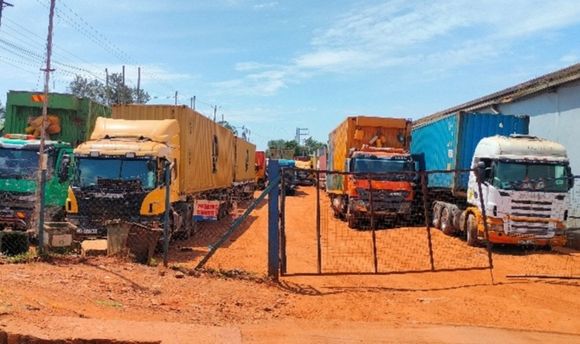
Across the road, signs of a wider infrastructure that both constrains and facilitates mobility are immediately visible: Cargo containers wait to be cleared, trucks are being serviced and queues at a gate indicate that involuntary immobility is as much a part of the men’s lives as mobility.
On the fringes of the settlement, small offices flanked by walls advertising mobile banking, airtime, photocopying services, and forms for customs, driving permits and passports are concrete reminders that connectivity, intermediaries and paperwork are as essential as fuel.
In between the office spaces, there are signs for boarding rooms and restaurants, places sustaining bodies, relationships, and information flows. In the midday heat, women stir food in large cooking pots on low stoves. Menu boards list specialties that cater to the diverse ethnicities who pass through or have settled here.
We pause at a small cafe with tidy shelves lined with bags of coffee and a seated outside space. A bold sign extolls the health virtues of coffee and ginger tea. The young stallholder says that her clients are primarily Somali traders and staff linked to the nearby Uganda Revenue Authority offices. She seems proud to tell us that they offer more than a hot drink, in fact, they are selling ‘well-being’ to men with stressful lives. Moving forward in the HIMM study, these visual cues may help us to start making sense of men’s mobility, revealing, in small ways, the spaces and actors relevant to safety, connectivity, and sociability of mobile individuals.
These early observations from Nakawa are informing how the HIMM project approaches mobility, health, and masculinity - not as abstract concepts, but as practices embedded in specific places, infrastructures, and social relationships. By paying close attention to the spaces and actors that support mobile men’s lives, the project seeks to co-design health innovations that are responsive, practical, and grounded in local realities.
Find out more about the HIMM project and its work in Uganda and Zambia.