
What does it mean for a place to remember?
This was one of the key questions shaping the keynote I recently delivered with my colleague Dr Victoria Bianchi at the Irish Society for Theatre Research Conference 2026, held at TU Dublin’s Grangegorman Campus.
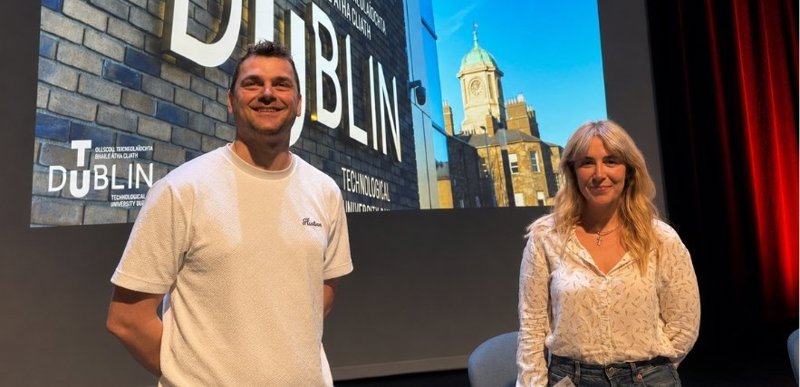
From the moment we arrived, it was clear that Grangegorman was more than a university conference venue. It’s a site with over 250 years of complex and often difficult history. It has previously served as a workhouse, hospital and prison. Walking through the campus, you’re constantly reminded that the past continues to shape how spaces are experienced in the present.
In many ways, that’s exactly what our work is about.
Finding connections between places
Our keynote, “Staging the Unseen: Hidden Histories and Performance Practice at Glasgow Green”, explored the connections between Grangegorman and Glasgow Green, Scotland’s oldest urban park and the focus of our ongoing research.
Although these two sites are geographically and culturally distinct, they share something important: both are shaped by layers of history that are visible in some ways and almost entirely hidden in others. Each site asks us to consider what has been preserved, remembered and celebrated, alongside what has been overlooked, obscured or pushed to the margins.
Heritage activity inevitably produces hierarchies of significance. Some events, figures and narratives are made prominent, while others remain absent from formal recognition. At the centre of Glasgow Green, Nelson’s Monument commemorates imperial and military achievement, while the Doulton Fountain presents Queen Victoria above a set of colonial figures. Even to the casual observer, the most visible heritage on the Green often privileges imperial, industrial and militaristic narratives.
Yet, Glasgow Green has also been a place where people have gathered for centuries to work, play, protest, celebrate, mourn and organise. It is a site of major political gatherings, civic rituals and collective action, as well as everyday experience: leisure, community, labour, family life and informal forms of belonging. Many of these stories, particularly those connected to marginalised communities, working-class histories and acts of dissent, are rarely given the same monumental status.
This is where our research begins: with the question of how performance practice might help us notice, recover and re-stage the histories that remain unseen.
Rethinking what counts as heritage
One of the ideas Victoria and I have been exploring is that heritage is found beyond monuments, plaques and official narratives. It lives in people’s experiences, in everyday practices, in fleeting moments, and in the memories and histories that remain contested.
In our research, we’ve been interested in how performance can help bring these overlooked histories into view. Our work does not attempt to present a single “correct” version of the past but opens up space for multiple voices and perspectives.
Performance, for us, becomes a way of asking questions: Whose stories are told? Whose are missing? And how might we begin to re-stage those silences?
From live performance to digital storytelling
Over time, this work has taken a number of forms. Early on, we developed site-specific performances in Glasgow Green, experimenting with how audiences (both invited and incidental) might physically move through the space and encounter its histories differently.
More recently, we’ve expanded this into digital work through the development of Glasgow Green: Alternative Histories, a mobile augmented reality app created in collaboration with colleagues from the University of St Andrews’ Smart Heritage initiative.
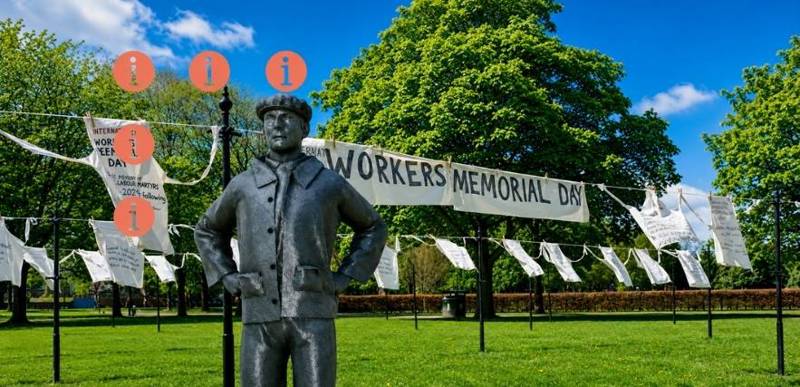
The app allows users to encounter virtual statues and digital interventions across the park, offering new ways to engage with stories that aren’t represented in the physical landscape. It’s been exciting to explore how digital tools can extend the reach of this work. But it also raises important questions.
Working critically with technology
While technologies like augmented reality offer powerful opportunities, they also come with responsibilities. How do we ensure these tools remain accessible? How do we avoid oversimplifying complex histories? And how do we represent different voices in ways that are ethical and inclusive?
These were important discussions during the keynote, and they’re ongoing questions within our project. For us, it’s not just about what technology can do, but how and why we use it.
Performance as a way of knowing
A central argument of our presentation was that performance operates as a mode of knowledge production, rather than a secondary means of communicating research findings
Through creative practice, we can explore aspects of place, memory and experience that don’t always emerge through traditional academic methods. Performance allows us to engage with the sensory, spatial and social dimensions of a site in ways that are often difficult to capture otherwise.
In that sense, practice and research are not separate activities, they are deeply intertwined.
Sharing the work at Grangegorman
Presenting this research at Grangegorman felt particularly meaningful. The site itself invited reflection on many of the themes we were exploring: memory, absence, transformation, and the politics of how histories are told.
It was also a reminder of the value of bringing together researchers, artists and practitioners to share ideas and approaches. These conversations are essential if we want to continue developing ways of working that are both innovative and socially engaged. We would like to extend our thanks to Dr Ciara Murphy who is the Vice President of ISTR and who invited us to TU Dublin.
Re-staging the unseen
Ultimately, our work is about trying to make visible the stories that are often left out - whether that’s through performance, collaboration, or digital experimentation.
Every place holds multiple histories. Some are well-documented and widely recognised. Others are quieter, harder to access, and sometimes deliberately overlooked.
If our research can contribute in a small way to bringing those stories into view - and encouraging others to think differently about the spaces they inhabit - then it feels like a worthwhile endeavour.


