
Public Bodies Climate Change Duties 2024/25 Summary Report
As a university rooted in service to our community and the wider world, we recognise the profound and far reaching impacts of climate change—both locally and globally. These changes present significant challenges to the long term sustainability of our institution. Yet they also reinforce the importance of our responsibility to lead by example: reducing our own emissions, equipping our staff and students with the knowledge and capabilities to drive change, and contributing meaningfully to collective climate action.
Our commitment to sustainability is not new. A major milestone was achieved in 2007, when our move to a new campus enabled a 38% reduction in annual operational greenhouse gas emissions. Since 2014/15 we have consistently reported our performance through the Public Bodies Climate Change Duties framework, ensuring transparency and accountability in our progress.
Looking ahead, our ambitions are clearly set out in the University’s Net Zero Strategy, approved by the University Court in 2023. We continue to advance the Climate Emergency agenda across the three interconnected pillars of sustainability—environmental, economic, and social. Our current target is to achieve net zero by 2044, supported by an interim reduction of 42% by 2030 (for Scope 1 and 2 emissions) using a 2020/21 baseline.
We are pleased to report strong progress in 2024/25. This year, the University achieved a substantial reduction in emissions, bringing our output down by 39% of the 2020/21 baseline. This represents a significant milestone and places us on track to meet our 2030 interim target. Alongside this, we have strengthened our governance arrangements through a comprehensive review of the Sustainability Advisory Committee, ensuring that our decision making structures are robust, informed, and aligned with our strategic priorities.
We have also continued to enhance the quality and transparency of our reporting, particularly through expanded coverage of both governance and climate adaptation activities. These improvements provide a clearer picture of our progress and help us identify areas for future action.
Finally, we have recognised that collaboration is central to achieving meaningful climate action. To that end, the University has invested in a shared services sustainability partnership to secure additional expertise and capacity. This shared resource is already supporting the acceleration of our emissions reduction initiatives and strengthening our ability to deliver on our long term commitments.
Our journey toward net zero is both ambitious and essential. It requires rigour, creativity, collaboration, and unwavering commitment. I am proud of the progress we have made and deeply grateful to the staff, students, and partners who continue to drive this work forward. Together, we will ensure that Queen Margaret University not only responds to the global climate challenge, but plays an active role in shaping a more sustainable and resilient future for all.
Stephen Scott, Chief Operations Officer
Public Bodies Climate Change Duties Reporting
Each year, public bodies in Scotland are required to complete Public Bodies Climate Change Duties (PBCCD) reporting under the Climate Change (Duties of Public Bodies; Reporting Requirements) (Scotland) Order 2015. This involves populating a mandatory report template with information on the previous year’s greenhouse gas emissions and activities, submitting this to Sustainable Scotland Network typically with an end of November deadline.
Topics covered in reports include:
- Profile of body
- Governance, management and strategy
- Corporate emissions, targets and project data
- Climate change adaptation
- Procurement
- Wider Influence
Queen Margaret University has completed PBCCD reporting based on the academic calendar since 2014/15. Previous reports are publicly available on the Sustainable Scotland Network website.
This document provides a written summary of the information included in Queen Margaret University’s 2024/25 report. At the time of writing, the University’s report for 2024/25 has yet to be uploaded by Sustainable Scotland Network.
Role and functions
Queen Margaret University aims to shape a better world through education, research, and innovation. In doing so, we enable individuals and communities to flourish. Our person-centred approach to learning makes us stand out from other universities, along with our focus on making society better. Our academic offering also distinguishes us. We dedicate ourselves to subjects where we can offer a distinctive offering - in healthcare; social sciences; creative arts; business, management, and enterprise; and primary and secondary teaching. Outward-looking, we have a strong ethos of partnership and collaboration. We are pioneers in inclusiveness, and we embrace people from all backgrounds.
The University recognises the potential range of climate change impacts that will influence our environment globally and locally and embraces the role that it has in contributing to the delivery of real significant change through reductions in their own carbon emissions, influencing understanding and behaviour change in our staff and students and undertaking and disseminating relevant teaching and research.
To support our commitment, the University has signed up to the UN-backed campaign ‘Race to Zero for Universities and Colleges’ and will align with Science Based Targets to ensure transparency and accountability in target setting and reporting of progress.
Institutional Profile
During the 2024/25 academic year Queen Margaret University had:
- Up to 513.76 full-time equivalent staff
- Buildings with a gross internal area of 46,784 m2
- 3,467 non-collaborative full-time equivalent students
- 277 UK collaborative full-time equivalent students
- A £57,701,632 budget
How is climate change governed?
Queen Margaret University is governed by the University Court, established by Queen Margaret University, Edinburgh (Scotland) Order of Council 2007, as amended by the Queen Margaret University, Edinburgh (Scotland) Amendment Order of Council 2019. The university is a company limited by guarantee (Company Number SC007335) and a charity (Scottish Charity No. SC002750) registered with the Office for Scottish Charities (OSCR). Court members are consequently Directors and also Charitable Trustees.
In 2014, a sustainability committee was established bringing together relevant activities from various historic work streams. The role of the Sustainability Committee with cross-institutional membership was later formalised within the governance structure and reports to the Senior Leadership Team (SLT) which is responsible, via the Principal, to the University Court. The revitalised Sustainability Committee was relaunched in early 2021 with a broad cross-institutional membership. A subsequent review of the Sustainability Committee's remit and membership is expected to take place at the beginning of the 2025/26 academic year. The Chief Operations Officer is accountable for Sustainability and the Director of Campus Services is responsible for delivery.
How is climate change action managed and embedded?
Operational aspects relating to climate change are delivered through the Campus Services Directorate which has responsibility for Estates, Engineering, Campus Operation and Commercial Services. Procurement responsibility sits within the Finance and is delivered via an embedded role of Head of Procurement through a partnership with the sector body Advanced Procurement for Universities and Colleges (APUC). Since January 2025 the University has received additional support through a Sustainability Project Manager shared with Borders College and Forth Valley College and hosted by the Environmental Association of Universities and Colleges (EAUC).
Estates and Campus Operations include energy efficiency, utility management, waste management and recycling, travel and transport, landscape, and biodiversity. The Deputy Director, Campus Services through the Heads of Service has responsibility for the delivery of objectives set out in the operational plan which is tracked through a series of performance management measures related to carbon, energy, and waste management. The operational plan is subject to annual review.
Academic activity related to teaching, learning, and research is governed by the Senate. Operationally, academic program reviews include an assessment of sustainability within the course content and work to curate resources on how to embed within the curriculum by our Learning Enhancement and Academic Development (LEAD) is being taken forward. Several academic programs currently include content intended to ensure that students are made aware of climate change and this is being rolled out across additional programs.
To support academic activity, there is continuing professional development in subjects/disciplines and their pedagogy, incorporating research, scholarship, and the evaluation of professional practices to meet the UK Professional Standards Framework for teaching and supporting learning in higher education. This includes consideration of appropriate contextual information related to climate change. Overarching aspects of the University's sustainability activity, including climate change, fall within the remit of the Sustainability Committee, which reports directly to the Senior Leadership Team. A detailed account of the University’s approach to climate change is available in its Net Zero Strategy, the current version of which guides action to 2028.
Completing the Public Bodies Climate Change Duties report each year is far more than a statutory requirement for us—it’s a valuable opportunity to bring together a comprehensive picture of our emissions across the University. The process allows us to reflect on how our activities have evolved over the past year and to clearly identify the impact of the projects and measures we’ve put in place. By tracking trends over time, we gain real insight into what’s working and where we need to focus next. It’s also been encouraging to see both the accuracy and breadth of our reported emissions improve year on year, giving us an increasingly reliable foundation for planning our path to net zero
Emissions from baseline year
Under the Greenhouse Gas Protocol, emissions are broken into three ‘scopes’:
- Scope 1 emissions are direct emissions from sources owned or controlled by the institution, including through burning fuel.
- Scope 2 emissions are indirect emissions from the generation of purchased energy, including grid electricity.
- Scope 3 emissions are all indirect emissions (not included in scope 2) that occur in the institution’s value chain. These include transport, waste, procurement, commuting, homeworking and student relocation.
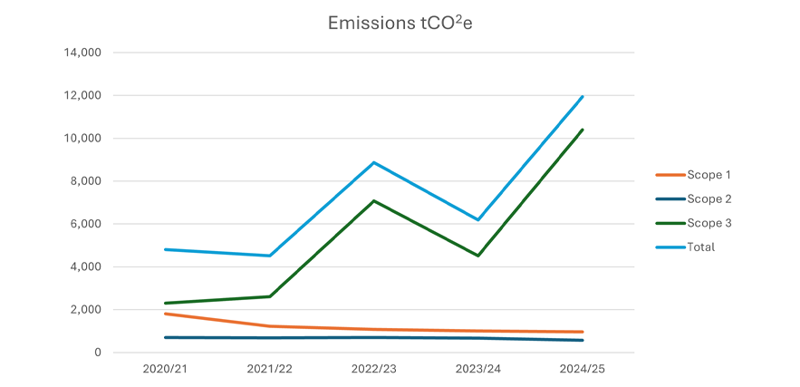
The following table summarises total emissions reported by Queen Margaret University since the University’s emissions baseline year (2021/21) in tonnes of carbon dioxide equivalent:
| Year | Scope 1 | Scope 2 | Scope 3 | Total | Units |
|---|---|---|---|---|---|
| 2020/21 | 1,801 | 700 | 2,309 | 4,810 | tCO2e |
| 2021/22 | 1,227 | 683 | 2,609 | 4,519 | tCO2e |
| 2022/23 | 1,081 | 707 | 7,078 | 8,867* | tCO2e |
| 2023/24 | 999 | 672 | 4,519 | 6,190 | tCO2e |
| 2024/25 | 966 | 569 | 10,404 | 11,940** | tCO2e |
*Supply chain emissions (scope 3) were reported for the first time, causing a substantial increase in total emissions.
**Changes to the spend-based methodology used to report supply chain emissions resulted in a further increase in total emissions.
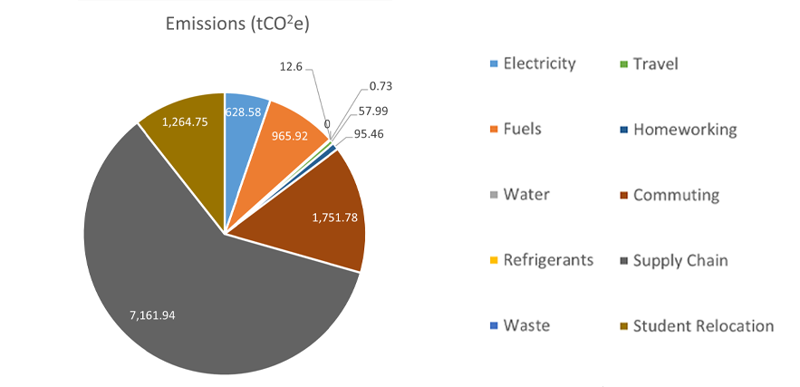
The following table summarises the various emissions sources reported in 2024/25:
| Emission source | Emissions (tCO2e) |
|---|---|
| Electricity | 628.58 |
| Fuels | 965.92 |
| Water | 12.6 |
| Refrigerants | 0 |
| Waste | 0.73 |
| Travel | 57.99 |
| Homeworking | 95.46 |
| Commuting | 1,751.78 |
| Supply Chain | 7,161.94 |
| Student Relocation | 1,264.75 |
| Total Emissions | 11,939.76 |
| % Baseline | 61% |
Progress against targets
The University aims to reach net-zero operational emissions by 2044 (scopes 1 and 2).
To achieve this long-term target, interim reduction targets of 42% by 2030 and 63% by 2038 (2020/21 baseline) will support monitoring of delivery and interventions the University may require to maintain course.
| Year / Emissions | 2020/21 | 2021/22 | 2022/23 | 2023/24 | 2024/25 |
|---|---|---|---|---|---|
| Scope 1 & 2 Emissions (tCO2e) | 2,501 | 1,909.86 | 1,788.63 | 1,671.43 | 1,534.93 |
| % Reduction | n/a | 24% | 28% | 33% | 39% |
How will the University align spending and resources to reduce emissions and deliver its emission reduction targets?
The approach adopted in proposing a net-zero date recognises the legislative drivers while assuming a pragmatic approach which recognises alignment with the planned elemental asset lifecycle renewal of the estate with lower embodied energy and low carbon technologies introduced.
The University holds no investments in fossil fuel companies.
Additionally, since January 2025 the University has invested in a shared services partnership, to secure additional resource to guide action to reduce emissions in the form of a Sustainability Project Manager based at EAUC and shared with two other institutions - currently Borders College and Forth Valley College.
The Joint Sustainability Partnership continues to be one of EAUC Scotland's most impactful areas of work. The partnership not only delivers on strategic sustainability milestones within Queen Margeret University, its experiences also directly inform and improve EAUC Scotland's sector-wide work, for example through our resource development. The partnership is an exemplar in sector strategic investment, collaboration and partnership working, offering up opportunities for similar partnerships to exist across the sector, including with a focus on different roles
How has the University assessed climate-related risks?
The University is in the process of completing a Climate Change Risk Assessment based on guidance provided by Adaptation Scotland and EAUC's Climate Risk Register Guide & Tool. This has been largely informed by regional projections produced by the Climate Ready South East Scotland project, based on 2018 UK Climate Projections (UKCP18) and an RCP8.5 scenario (broadly equivalent to 4C Global Warming Level by 2080). Additional sources were included for specific risks e.g. SEPA flood risk mapping. The Climate Change Risk Assessment is expected to be complete early in the 2025/26 academic year and will be used to inform a more detailed plan outlining the adaptation measures to be undertaken. The Climate Change Risk Assessment considers a wide range of risks, including:
- high temperatures
- flooding
- storm events
- changing rainfall patterns
- impacts on food supply and security
- external disruption to infrastructure
IES Building Modelling has been completed currently utilising the UKPC09 data set to analyse the overheating impacts of climate change on the primary campus non-domestic buildings. Updated IES building modelling and Hysopt hydraulic modelling will be utilised to inform refurbishment proposals related to engineering systems and future energy strategy. The University also has also completed commercial data collation in relation to SEPA Flood Risk Mapping and assessment of Potentially Vulnerable Area's taking account of the local projections for climate change.
The University along with consultants for the joint venture Edinburgh Innovation Hub, carried out a Flood Risk Assessment in relation to the proposed future development of the Edinburgh Innovation Hub, taking account of the recently published data, SFRA, and the data collated as part of its own review. The development principal of the Edinburgh innovation Hub supports the aims of the East Lothian Environment Strategy. An engineering review of surface water drainage capacities and flood risk of the QMU Campus was reviewed and updated as part of the development of the Edinburgh Innovation Hub building.
What arrangements does the University have in place to manage climate-related risks?
Our Net Zero Strategy 2023-2038 sets out the measures we will implement to deliver tangible, measurable and achievable outcomes which contribute to achieving the ambitions and vision of the Scottish Government in its Climate Change Plan. Reporting and monitoring the progress of the CCAP will align with the Scottish Funding Council Outcome Agreement guidance.
The Net Zero Strategy outlines the objectives of the University over the duration of the Strategy and how it intends to implement and measure these, including action toward adaptation. This includes the overall aim to formalise an institution wide Adaptation risk assessment, utilising the toolkits provided by Adaptation Scotland and others, and to engage all levels of the University in this process. Progress against the Net Zero Strategy is tracked through annual monitoring and reporting, including to the University Court.
As mentioned, the University is in the process of completing its first Climate Change Risk Assessment, using resource from Adaptation Scotland, EAUC and the Climate Ready South East Scotland project. This has involved a process of consultation with relevant risk owners from across the University and is due to be completed toward the beginning of the 2025/26 academic year. The Climate Change Risk Assessment also includes an ongoing log of weather events that cause disruption or damage to the University, to build a record of these events to track any emerging patterns. Any disruption caused by extreme weather events, which we expect to become more frequent and severe due to climate change, is managed through the University's Business Continuity procedures.
What action has the University taken to adapt to climate change?
During 2024/25 the University's Sustainability Committee has undergone a reorganisation, including an update to its formal remit. This has included a renewed focus on climate change adaptation as a priority in the short term, leading to the development of the Climate Change Risk Assessment and the University's use of Adaptation Scotland's Benchmarking Tool for the first time - completed by Committee members.
The University's campus was designed to “develop a sustainable community for learning and life”. The result included numerous measures which contribute to a resilient campus:
- The surface water from the site and the buildings are managed via a site-wide SUDS system;
- Building design and drainage systems account for the likelihood of increased frequency and intensity of rainfall and surface water drainage system include features to manage flow;
- Critical and essential services are supported by a local generator.
Since the construction of the campus, the University has undertaken studies to better understand the risks presented posed by climate change and the subsequent adaptation measures that will be needed, in addition to the overarching Climate Change Risk Assessment which is underway:
- Flood Risk Assessment in relation to development of the Edinburgh Innovation Hub.
- Modelling analysing overheating impacts of climate change on campus non-domestic buildings.
- Engineering review of surface water drainage capacities and flood risk reviewed and updated as part of the development of the Edinburgh Innovation Hub building
Concerning supply chains, through Scottish University and College Sectors Supply Chain's Climate & Ecological Emergency Strategy 2022 to 2030, the sector is committed to:
- Develop future new adaptation related needs into long term specifications/supply planning for local and collaborative procurement and collectively share emerging.
- Adapt specifications for existing requirements to take account of the need for adaptation.
- Build adaptation related supply chain risks into institutional risk registers.
- Make more use of multiple source / multi-region strategies (while being aware of increased risk from lengthy supply chains) to build resilience.
- Adapt sourcing plans to limit risk from lengthy more volatile supply chains that will become increasingly unreliable as the impact of climate change increases.
What contribution has the University made to helping deliver the Scottish National Adaptation Plan?
In 2024/25 the University used Adaptation Scotland's Benchmarking Tool for the first time.
Through the University's functions we anticipate to contribute across the Scottish National Adaptation Plan 2024-2029’s (SNAP3) outcomes, with particular relevance to;
- C1: Regional and place-based collaborations
- PS1: Public body duties and capacity
- PS2: Public service and infrastructure resilience
- B4: Economic development and supply chains
- IA3: Knowledge advocacy.
QMU is represented on Adaptation Scotland's Public Sector Climate Adaptation Network through the shared Sustainability Project Manager, who is also a member of the Climate Ready South East Scotland initiative's Advisory Group and provided feedback on the draft SNAP3 via EAUC.
How have procurement policies contributed to compliance with climate change duties?
QMU’s procurement strategy supports the University’s compliance with the climate change duties. Our strategic procurement objective no 2 is to embed sound ethical, social and environmental policies within the procurement function and to comply with relevant Scottish, UK and EU legislation in performance of the Sustainable Procurement Duty. This objective is mapped to QMU’s strategic goal to embed sustainability across our portfolio and practices.
QMU’s procurement strategy commits to undertake regulated procurements in compliance with the sustainable procurement duty. The University will also seek to take account of climate and circular economy in its procurement activity. Consideration of environmental, social and economic issues and how benefits can be delivered through the procurement will be made, where appropriate and on a contract-by-contract basis.
In response to the global climate emergency the University will align corporate commitments to work towards net zero greenhouse gas emissions framework agreements wherever possible. The University has a strong focus on supporting responsible procurement, in particular on climate and circular economy. The University will seek to support circular economy and promote strategic decisions on demand management and procuring for re-use, re-design and remanufacture. It will prioritise where greatest impact can be made
QMU is also using the From Now to 2030 (FNT2030) templates to plan its approach to reducing carbon emissions in line with the Primary Impact Area for Climate Change (PIACC) Guide.
How has procurement activity contributed to compliance with climate change duties?
The procurement team, where appropriate, includes technical evaluation questions on environmental sustainability in relevant tenders. Suitable questions are discussed with the stakeholders and are tailored to the goods, services or works to be purchased. Bidders' responses to these questions are scored and therefore contribute to the process in which bidder is awarded the particular contract. Large scale procurements will have inbuilt considerations for Scope 1, 2 and 3 carbon emissions and evaluation criteria concerning Scope 1, 2, and 3 carbon emissions will be built into procurement processes. Suppliers and contractors will also be encouraged to work with QMU to develop and implement plans on how to reduce all types of carbon emissions during the life of contracts.
Supporting best practice
A significant proportion of our procurement is awarded via collaborative framework agreements, which have been drawn up by APUC or other sectoral and national procurement consortia. The climate change duties overlap with several obligations incumbent upon the University under the Procurement Reform (Scotland) Act 2014, including in provision of community benefits, Living Wage and fairly and ethically traded goods and services. QMU follows sector best practice in ensuring procurement policies are in place which contribute to compliance with climate change duties. As part of our procurement policy, we have adopted tools and practices from APUC - the procurement centre for Scotland’s universities and colleges - which address climate risks.
Data received from our external consultants is subject to monthly review and is validated against historic and benchmark figures by the Estates and Engineering division of the Campus Services Directorate. Data input is initially carried out by the Campus Services Administrator with support from the Sustainability Project Manager. This is then verified by the Head of Estates & Engineering. Finally, the Director of Campus Services audits this input.
The University participates in the annual peer validation for small institutions hosted by the Environmental Association for Universities and Colleges (EAUC), including a review meeting on 6th November. Data in relation to energy and carbon is also submitted annually to the Higher Education Statistics Agency (HESA) as part of the Estates Management Return (EMR).
The key data for energy emissions is provided by an external professional energy manager engaged by the University through our Facilities Management contract. Scope 3 Travel and Transport emissions are validated by our Travel and Transport Consultant subject to an approved methodology agreed with their Carbon Team.
"The Sustainability Advisory Committee seeks to support embedding issues of sustainability, including climate change, across our portfolio of academic programmes, research and knowledge exchange activities. The Learning Enhancement and Academic Development (LEAD) Centre has a current focus on Sustainability in Learning, Teaching and Assessment, co-creating networks to providing guidance, toolkits and examples of good practice. The QMU Student Experience Strategy has, as one of its overarching themes, Sustainability and Social Justice. Alongside this the Sustainability Advisory Committee regularly provides a wide-range seminars, symposia, and discussion and reading groups.
A number of areas of strength exists across our teaching and research activities. For example, the Business School’s commitment to UN Principles for Responsible Management Education (PRME) leading to an increased number of modules engaging with sustainability issues. Likewise within Psychology, Sociology and Education, there are dedicated modules across each year group with an explicit focus on sustainability. While programmes in Initial Teacher Education (Primary and PGDE) have sustainability themes built in and assessed in each subject.
QMU has a strong local and national reputation in delivering, researching and engaging with the local and wider community in relation to how Outdoor Learning supports the sustainability agenda. This has included supporting East Lothian Climate Action and Green Futures events; a local play charity ‘Choose Play’; the Recharge Tranent- local Youth group; and the Brownies. Activities have included planting a Wee Forest, monitoring biodiversity, Citizen Science, and forest school activities."
Alan Bainbridge, Professor of Education and Sustainability Advisory Committee Convenor
Queen Margaret University works in partnership with various organisations to address climate change in operations:
- Supported by Cycling Scotland, the University developed and sustained the 'Cycle Connections' cycling project, including bike hire. The University received the Cycle Friendly Employer and Cycle Friendly Campus (with Distinction) awards from Cycling Scotland.
- The University is an active member of the Environmental Association for Universities and Colleges (EAUC) to share sustainable practice and support opportunities for collaboration. This included Sustainability Project Manager role which is shared between EAUC (Scotland), Borders College, Forth Valley College and Queen Margaret University.
- The University Participates in the East Lothian Community Rail Partnership to ensure that rails services delivered on the East Coast rail line are improved.
Queen Margaret University is home to The Institute for Global Health and Development (IGHD), a multidisciplinary centre for postgraduate education and cutting-edge research. IGHD’s research works to address contemporary health and development challenges in low- and middle-income countries and their connection to global systems and trends, often with links to climate change:
- TropEd is a global network of 27 higher education institutions in International Health from 19 countries. It provides postgraduate opportunities for education and training contributing to sustainable development and jointly offers a Masters programme in International Health. The MSc International Health offered at IGHD is recognised by the tropEd programme in International Health since the commencement of the association in 1997.
- ReBUILD for Resilience examines health system resilience in fragile settings experiencing violence, conflict, pandemics and other shocks and are an international research consortium that aims to produce high-quality, practical, multidisciplinary and scalable research which can be used to improve the health and lives of many millions of people.
Academic staff from across the University are also addressing climate change in their work, including:
Kill Your Darlings (II) by Anthony Schrag’s sits at the intersection of three significant issues facing the Museum sector: the pressure to reach Net Zero, Disposals of museum collection objects, and Community Engagement. This work proposes that these are not intractable, individual problems, but potential solutions to each other, utilising these pressures to find creative ways to ‘think through’ these contexts. As a research-led creative programme, it partners with the Aberdeen Art Gallery and Archives, to seek solutions to these complex, interrelated problems. It would explore how these pressures within museums can be considered as potential shared solutions rather than as distinct and un-connected, and aims to develop public projects (i.e., exhibitions,) as well as traditional dissemination projects (papers, performances etc).
Arts Managers and a Regenerative Mindset by Alice McGrath addresses the complex issue of sustainable development for arts managers, as although there is increasing good practice in the area, it is now argued that sustainability and net zero is not enough. Some argue that a new paradigm is required to move beyond sustainability and aim instead for net positive, regenerative outcomes (Stafford et al, 2018; RSA, 2021; Ichioka and Pawlyn, 2021, SITRA 2023), but creating and sustaining a paradigm shift is a complex process that requires collective action and new ways of being. This research explores a framework for educators to use to help develop more regenerative mindsets in Arts Managers, and works with both students and other (international) Universities to develop insights to help develop this paradigm shift within the cultural sector.


