
QMU launches first Anti-Ableism Challenge Badge for Girlguiding UK
Thousands of young people across the UK are set to learn about disability, inclusion and equality through a new Anti-Ableism Challenge Badge launched by Queen Margaret University (QMU) for Girlguiding UK members.
Co-created with disabled people, the badge introduces simple, engaging activities that help young members understand disability, challenge stereotypes and take practical steps to make their communities more inclusive. Designed for Rainbows, Brownies, Guides, Rangers and volunteers, the badge syllabus also builds awareness of disability history, rights and equity.
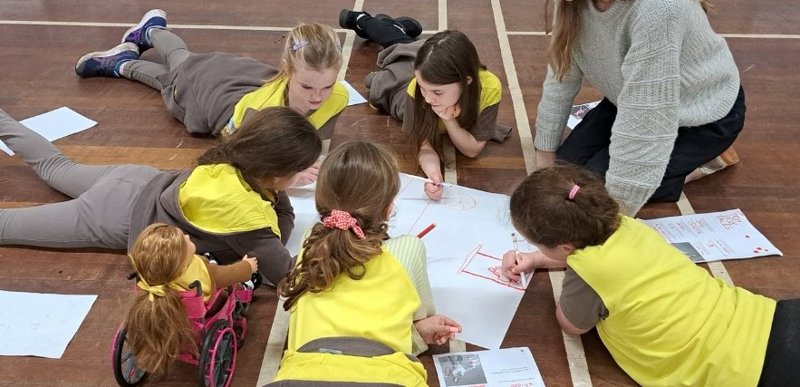
Developed by the Toy Box Diversity Lab at Queen Margaret University, the badge has already been successfully piloted in Girlguiding Scotland units in East Lothian. It will now be available as an optional activity alongside the core Girlguiding programme, offering flexible, low-cost or free ways for young people across the UK to explore inclusion and accessibility.
Dr Siân Jones, Senior Lecturer in Psychology at Queen Margaret University and co-founder of the Toy Box Diversity Lab, said: “As a disabled person myself, this new badge represents a really positive step forward in the growing momentum around anti-ableism work with young people. Too often, disability is left out of early learning, but this badge helps change that by creating space for reflection, discussion and action.
Disabled children and young people often encounter barriers that non-disabled people don't notice, from inaccessible environments to assumptions about what they can and cannot do. Ableism can be subtle, but its impact is significant. By introducing conversations about disability, fairness and accessibility at an early age, we can help create more inclusive communities where disabled people are valued, respected and included. We hope this badge will give girls and leaders the confidence to recognise barriers, challenge them, and become advocates for positive change.
Activities that can be completed to gain the Anti-Ableism Challenge Badge include adapting games to make them more inclusive, redesigning spaces to improve accessibility, learning the Braille alphabet, and exploring disabled role models and representation. Girlguiding UK leaders are supported with practical guidance, discussion prompts and information-based resources.
One of the Anti-Ableism Badge co-creators said: “It has been really affirming to me as a disabled person to be part of the development of these resources. I think it is really important to have these resources for young people to bring it to the forefront of their awareness at a young age. As a former Rainbow and Brownie, I would have appreciated this in my unit.”
Developed through QMU’s Toy Box Diversity Lab, the Anti-Ableism Challenge Badge builds on the Lab’s wider work addressing inequality, representation and social justice in educational and youth settings. The Lab works collaboratively with communities to ensure disabled people’s voices are at the heart of developing training, resources and inclusive practice.
At the Toy Box Diversity Lab, we aim to directly tackle representation and understanding of disability through play, imagination and discovery. The introduction of anti-ableism into Girlguiding’s suite of challenge badges is an example of how collaborative work can translate research into tools that support real change in educational and youth settings.
More information about the Toy Box Diversity Lab.
Sign up for the Anti-Ableism Challenge Badge.
For further media information contact: Queen Margaret University, Edinburgh, E: pressoffice@qmu.ac.uk.


